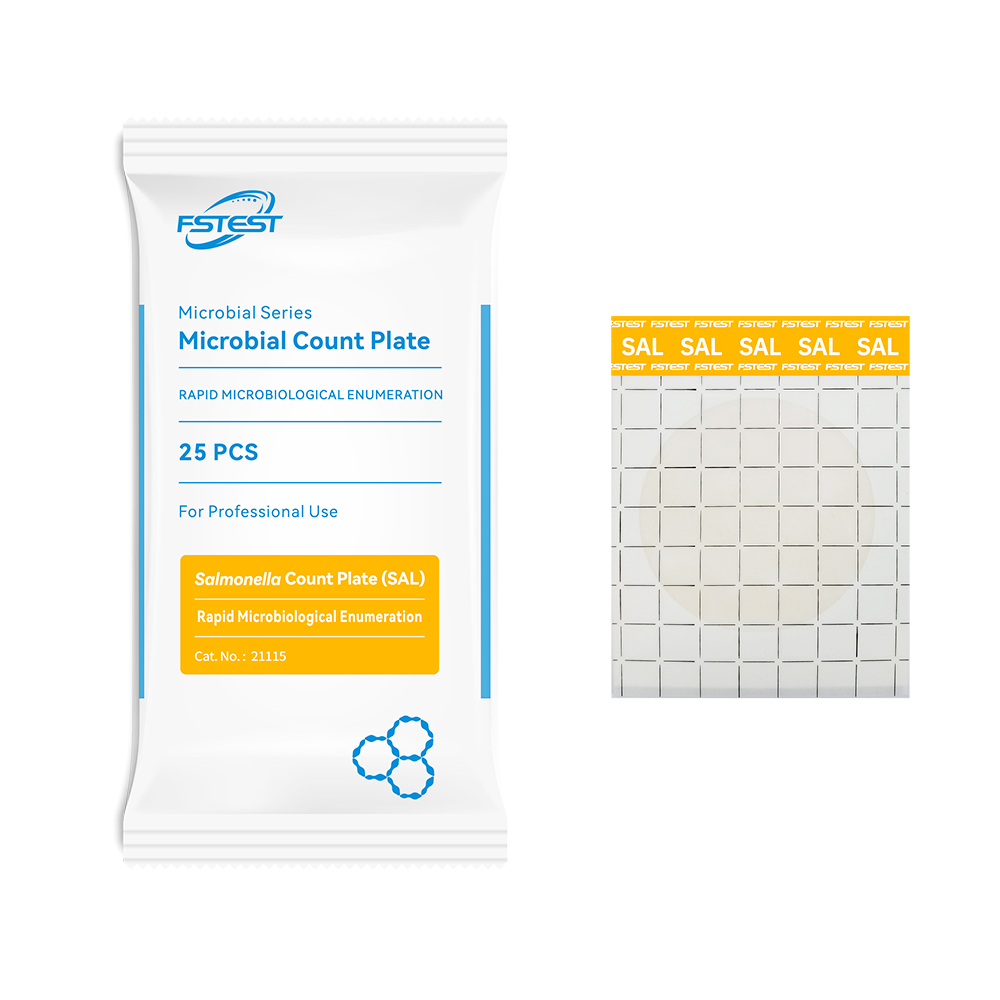

FSTest Salmonella Count Plate (Gel-Type) (25 Tests)
Product Overview
The FSTest Salmonella Count Plate (Gel-Type) is a pre-prepared, ready-to-use microbiological culture medium designed for the rapid and reliable screening of Salmonella across various food groups and water samples. This advanced system replaces traditional, labor-intensive agar preparation, autoclaving, and petridish pouring workflows.
By combining a basal selective nutrient medium with a cold-water-soluble gelling matrix and highly specific biochemical chromogenic indicator systems, this testing plate simplifies pathogen identification. It is an essential tool for food processing plants, commercial kitchens, dairy labs, and environmental monitoring agencies looking to optimize their HACCP safety programs.
Product Highlights & Key Benefits
· Accelerated Incubation Timeline: Delivers reliable Salmonella screening results within an optimal window of 18 to 24 hours, significantly cutting down product holding times compared to conventional agar methods.
· High Chromogenic Differentiation: Formulated with active indicators that turn Salmonella into easily identifiable red or reddish-brown colonies surrounded by a clear yellow acid halo, neatly differentiating them from background flora.
· Versatile Testing Protocols: Accommodates two distinct testing pathways—Direct Testing for heavily loaded samples and an Enrichment Protocol to catch trace contamination in highly sensitive matrices.
· Built-In Grid System for Overload Estimation: Features a standardized square grid layout overlaying the inoculation zone. If colonies are too dense to count directly, operators can calculate the average of a few squares and multiply by 28 to estimate total loads.
· Ambient Logistics Advantage: Unopened test plates can be transported and stored at room temperature for up to 15 days, providing notable shipping cost benefits before cold-refrigeration storage.
Technical Principle & Color Expression
The FSTest™ Salmonella Count Plate operates on a selective enzymatic and metabolic reduction framework. The pre-loaded dry matrix integrates specific nutrients, a selective cold-water gelling system, and biochemical indicators.
During incubation, living Salmonella cells produce dehydrogenase enzymes as part of their metabolic pathway. These enzymes reduce the integrated chromogenic agent to form a stable red color, staining the colony. Simultaneously, lactose/sugar fermentation drops the localized pH, turning the immediate background into a yellow acid zone.
Salmonella Metabolism → Dehydrogenase Reduction (Red Colony) + Acid Fermentation (Yellow Halo)
• Salmonella: Appears as red or reddish-brown colonies with a yellow acid halo.
• Non-Target Microorganisms: Manifest as green, blue, or purple colonies, minimizing false-positive confusion.
Specifications & Limit of Detection
Parameter | Product Specification |
Target Organism | Salmonella spp. |
Applicable Matrices | Water, Beverages, Dairy Products, Meat, Eggs, etc. |
Limit of Detection (LOD) | 1 CFU/g (or mL) |
Incubation Parameters | 36 ± 1°C for 18–24 hours |
Final Result Report | Reported as Salmonella 'Detected' or 'Not Detected' in 25 g (or 25 mL) |
Step-by-Step Procedure
1. Sample Treatment
· Pathway A: Direct Testing (High Bacterial Load): Weigh 25 g (or mL) of the sample into a container with 225 mL of sterile water, saline, or phosphate buffer. Homogenize with a paddle blender for 1–2 minutes to obtain a 1:10 homogenate. Perform serial dilutions (1:100, 1:1000) as required.
· Pathway B: Enrichment Testing (Low Bacterial Load / Trace Pathogens): Weigh 25 g (or mL) of the sample into a bag containing 225 mL of Salmonella Rapid Enrichment Supplement. Homogenize for 1–2 minutes. Incubate statically at 36 ± 1°C for 7–8 hours before moving to inoculation.
2. Inoculation Workflow
· For Direct Inoculation: Lay the plate flat and uncover the top protective film. Pipette 1 mL of the sample solution in a circular motion onto the center of the inoculation area. Lower the film carefully to completely avoid trapping air bubbles. Smoothly spread using a plate spreader. Let it sit for at least 10 seconds to solidify. Do not reopen the film after spreading.
· For Inoculation After Enrichment: Add 1 mL of sterile water onto the center of the plate, lower the film, and spread it. Allow the plate to stand flat at room temperature (20–28°C) away from light for at least 2 hours to complete hydration. (Must be used within 8 hours). Lift the top film of the hydrated plate. Aseptically pick up one loopful of enrichment broth using a 1 µL inoculation loop. Touch the loop to the moist substrate, then gently streak it back and forth across the plate surface at a 20–30° angle without puncturing the medium. Lower the film.
3. Incubation Settings
Stack the plates horizontally with the transparent film side facing upward. To ensure uniform heat distribution, do not stack more than 20 plates together at one time. Incubate at 36 ± 1°C for 18–24 hours.
Results Determination & Validation Check
· Positive Identification: Count the red/reddish-brown colonies that present a clear yellow acid halo. Confirmatory standard laboratory testing is recommended to verify positive results.
· Overload Warning: If the entire incubation circle shifts to solid orange-yellow or light green, the bacterial load is excessively high; further sample dilution is required.
· Control Validity Check: Run duplicate plates for each dilution along with one blank negative control. If any colonies develop on the blank control plate, the entire test batch is strictly invalid.
Crucial Technical & Safety Precautions
· ⚠️Biosafety Standard (BSL-2): Because Salmonella is a major infectious pathogen, operators must wear protective laboratory coats and disposable gloves. All diagnostic workflows should be conducted within a certified Biosafety Level 2 (BSL-2) laboratory.
· ⚠️Handling Restrictions: When moving plates into or out of the incubator, never apply physical finger pressure directly to the central circular matrix, as this can disrupt the gel alignment.
· ⚠️Light & Cleanliness Guard: Avoid exposing plates to direct sunlight, strong UV rays, or prolonged fluorescent light. Sample pH should ideally fall between a neutral 6.5 and 7.5; adjust using 1 mol/L NaOH or 1 mol/L HCl if required.
· ⚠️Disposal: Dispose of used plates immediately in line with regulated laboratory biohazard waste disposal laws.


