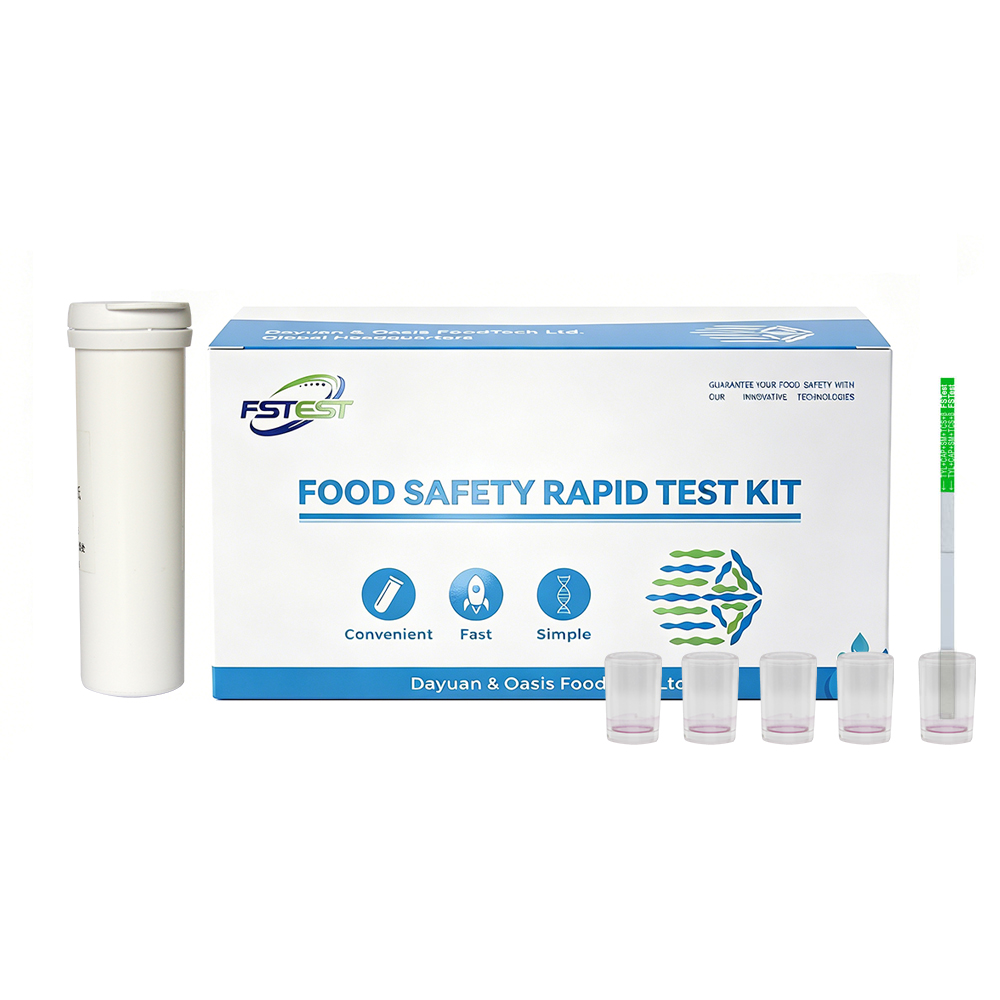

FSTest Beta-Lactams + Tetracyclines +
Streptomycins + Chloramphenicol + Tylosin 5-in-1
Rapid Test Strip (96 Tests)
Product Overview
The FSTest 5-in-1 Rapid Test Strip is a professional-grade, industrial multiplex screening tool engineered for the simultaneous, independent detection of five major high-risk veterinary drug residue categories in dairy products: Beta-Lactams, Tetracyclines, Streptomycins, Chloramphenicol, and Tylosin. Antibiotic and antimicrobial residues in dairy production present critical food safety challenges and are subject to strict Maximum Residue Limits (MRLs) or absolute zero-tolerance prohibitions worldwide. This multi-analyte assay provides a comprehensive compliance auditing solution for dairy farms, raw milk collection stations, pasteurization plants, milk powder manufacturers, and import-export quality control laboratories.
By consolidating five distinct biochemical screenings into a single, straightforward assay loop, this kit eliminates the necessity for complex multiple extraction protocols or separate ELISA microplate platforms. It compresses essential multi-residue milk verification into a simplified, field-ready workflow.
Product Highlights & Key Benefits
· High-Speed Field Screening: Map out a comprehensive safety profile spanning five major contaminant groups in a single test sequence, providing clear visual results within just 8 minutes.
· Ultra-High Sensitivity Thresholds: Calibrated to deliver highly sensitive qualitative screenings that comfortably meet or surpass rigid regulatory cutoffs: Tylosin down to 10–20 µg/kg; Chloramphenicol down to a strict 0.3 µg/kg cutoff; Streptomycins down to 50 µg/kg; Tetracyclines down to 5 µg/kg; Beta-Lactams down to 2–4 µg/kg.
· Extensive Dairy Matrix Adaptability: Formulated for multi-matrix sample validation, providing reliable results for raw milk, pasteurized liquid milk, and reconstituted milk powder formulations.
· Zero-Ambiguity Visual Layout: The reading zone incorporates five separate invisible Test lines (T1, T2, T3, T4, T5) paired with an integrated internal Control (C) line, allowing straightforward interpretation without cross-line visual interference.
· Heavy-Duty Commercial Specification: Supplied in a bulk 96-test pack containing 96 test strips and 96 dry-reagent precoated microwells, making it perfectly optimized for high-throughput batch auditing.
· Institutional Shelf-Life Flexibility: Offers a full 24-month sealed storage lifespan when kept under proper refrigerated parameters (2–8°C), featuring an advanced ambient tolerance profile that permits room-temperature transport and field deployment for up to 30 days.
Technical Principle: Multiplex Lateral Flow Immunochromatography
The test strip utilizes a competitive lateral flow immunochromatographic assay mechanism. The reaction zone features five invisible independent Test lines (T1: Tylosin, T2: Chloramphenicol, T3: Streptomycins, T4: Tetracyclines, T5: Beta-Lactams) along with a terminal Control (C) line.
Dairy Sample Resuspension + Microwell Reagents -> Capillary Lateral Flow -> Competition with Pre-coated Recombinant Antigens -> Faded or Absent T-Line (Residue Detected Response)
When the processed liquid milk sample is applied, the fluid flows laterally upward across the strip via capillary pressure, reacting with specialized pre-coated recombinant antigens. If the target residues are absent or safely below the analytical cutoff, a strong color band binds at the corresponding T line. When a contaminant meets or exceeds the threshold, it competitively inhibits antibody binding, causing that specific T line to become visibly lighter or disappear completely compared to the C line. The Control (C) line must always develop normally to indicate a valid testing run.
Step-by-Step Operating Instructions
Sample Matrix Preparation
Ensure both the dairy milk samples and the test components are equilibrated to an operating environment between 20 to 40°C. The milk sample must be thoroughly homogenous. Refrain from utilizing samples presenting heavy clumping, murky appearance, odd scents, or other sensory anomalies. For milk powder samples, completely dissolve the powder in distilled water at a strict 1:9 ratio (e.g., mix 1 g of dry milk powder with exactly 9 mL of distilled water).
Assay Procedure
· Open the package container, remove the required number of test strips and reagent microwells, and apply necessary labels or markings. Re-cap the tube tightly immediately after usage to shield remaining strips from ambient moisture and contamination.
· Place the selected microwells on the incubator. If the room temperature is securely above 20°C, it can be incubated directly at room temperature; if below 20°C, you may need to use an incubator and set the incubation control temperature precisely at 40°C.
· Pipette exactly 150 µL of the milk sample into the precoated microwell. Mix slowly but thoroughly by repeatedly pipetting up and down using the pipette fluidics, and then incubate the mixture for exactly 3 minutes.
· Insert the test strip into the microwell with the sample loading end facing downward and start timing immediately.
· Interpret the visual results exactly at 8 minutes. Visual readouts are strictly invalid after 10 minutes due to post-reaction chemical shifts.
Visual Results Determination Guide
· Negative (-): The C, T1, T2, T3, T4, and T5 lines all develop strong, distinct red bands whose intensities match or exceed the Control (C) line. This indicates that all five contaminant groups are below the targeted regulatory cutoffs.
· T1 Positive (+): The T1 line is visibly lighter than the C line or disappears completely, while the other lines develop normally. This indicates Tylosin residue meets or exceeds the threshold cutoff limit.
· T2 Positive (+): The T2 line is visibly lighter than the C line or fails to appear, indicating that Chloramphenicol residue meets or exceeds the regulatory cutoff threshold limit.
· T3 Positive (+): The T3 line is visibly lighter or absent, confirming that Streptomycins residue meets or exceeds the cutoff.
· T4 Positive (+): The T4 line is visibly lighter or absent, confirming that Tetracyclines residue meets or exceeds the threshold.
· T5 Positive (+): The T5 line is visibly lighter or absent, confirming that Beta-Lactams residue meets or exceeds the threshold cutoff limit.
· Multiplex Positive (+): Any combination of multiple faded or absent T lines indicates simultaneous multi-residue veterinary contamination.
· Invalid: The Control (C) line fails to develop a visible color band, regardless of the appearance of any T lines. This signals an operational error or a compromised strip; re-testing with a brand new strip is strictly required.
Storage & Packing Specifications
· Kit Capacity:96 tests per kit (96 test strips, 96 microwells, and 1 user manual).
· Storage Environment:The test strip can be stored and transported at room temperature within 30 days, and then kept in the refrigerator at 2–8°C for a full sealed shelf-life of 24 months. Do not freeze.


